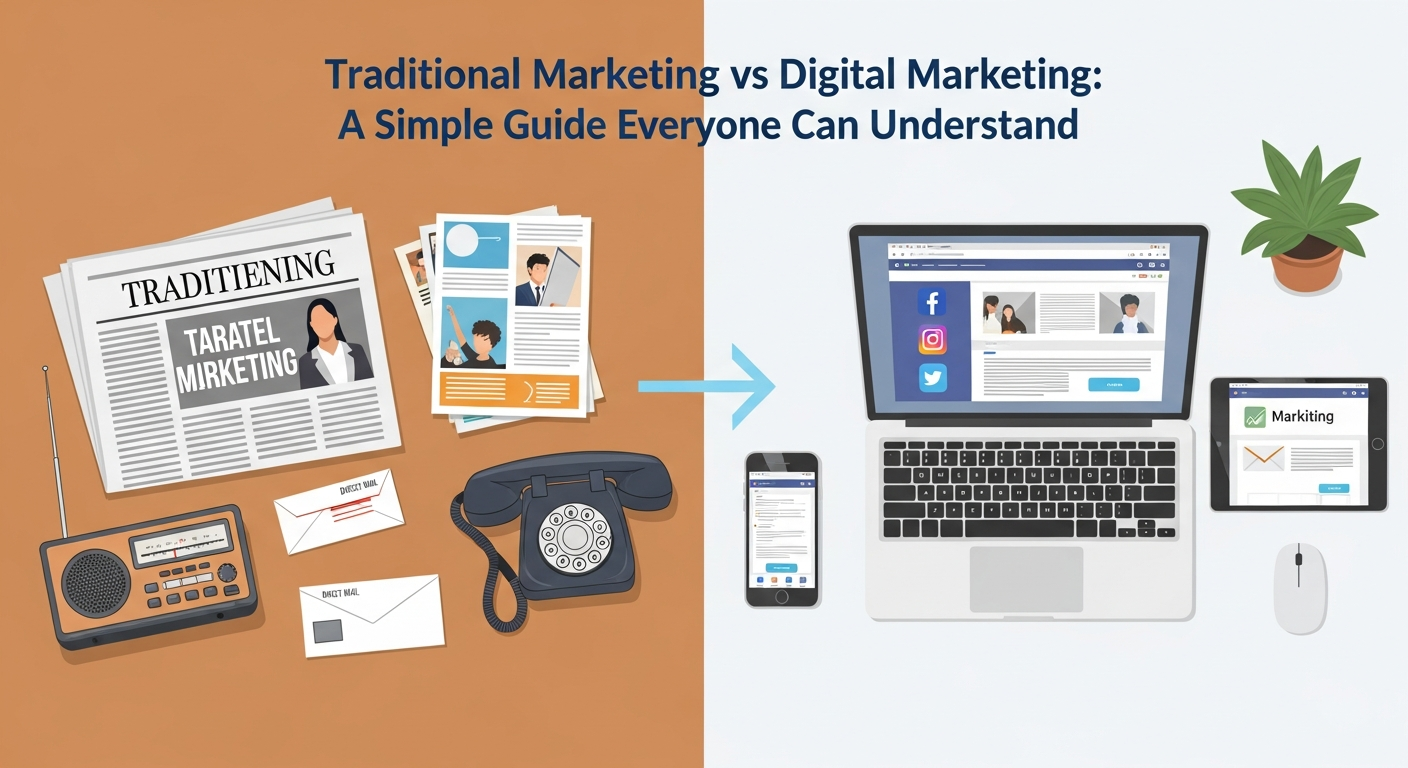
Marketing helps businesses tell people about their products.
Today, many people feel confused about traditional marketing vs digital marketing.
Both methods try to attract customers, but they work in very different ways.
In the past, businesses used newspapers, TV, and posters.
Now, many brands use websites, social media, and search engines.
This big change makes people ask one simple question.
Which one works better today?
This guide explains traditional marketing vs digital marketing in the easiest way possible.
You will learn how each method works, how much it costs, and who should use it.
Real examples are included to build trust and clarity.
By the end, you will know which marketing fits your business goals best.
What Is Traditional Marketing?
Traditional marketing is the old and classic way of advertising.
It focuses on reaching people offline using physical media.
Many brands still use it to build trust and local awareness.
Common examples include TV ads, radio ads, newspapers, flyers, and billboards.
You often see these ads while watching TV or driving on the road.
They are designed to reach a large audience at once.
In the traditional marketing vs digital marketing debate, traditional methods are less flexible.
Once an ad is printed or aired, it cannot be changed.
It also costs more and is harder to measure.
However, traditional marketing still works well for local businesses.
Restaurants, real estate, and retail stores often benefit from it.
People also trust printed ads more than online ads sometimes.
What Is Digital Marketing?
Digital marketing promotes products using the internet and digital devices.
It helps businesses reach people online in real time.
This method is very popular today.
Examples include social media marketing, email marketing, SEO, and online ads.
People see these ads on Google, Facebook, YouTube, and websites.
You can target users by age, location, or interest.
When comparing traditional marketing vs digital marketing, digital marketing is more flexible.
You can edit ads anytime and track results instantly.
This makes it easier to improve campaigns.
Digital marketing works well for small and large businesses.
It is cheaper and gives better control over spending.
That is why many companies prefer it today.
Key Differences Between Traditional Marketing vs Digital Marketing
The main difference is how people receive the message.
Traditional marketing reaches people offline.
Digital marketing reaches people online.
Another difference is communication style.
Traditional marketing is one-way communication.
Digital marketing allows two-way interaction.
In traditional marketing vs digital marketing, cost also matters.
Traditional ads usually cost more.
Digital ads can fit small budgets.
Tracking results is another major difference.
Traditional marketing is hard to measure.
Digital marketing shows clicks, views, and sales clearly.
Both methods have value.
The right choice depends on business goals and audience type.
Cost Comparison: Which One Is More Affordable?
Cost plays a big role in traditional marketing vs digital marketing decisions.
Traditional ads are often expensive.
TV and newspaper ads require high budgets.
Printing flyers and posters also adds cost.
You must pay even if results are poor.
Small businesses may struggle with these expenses.
Digital marketing is usually more affordable.
You can start ads with small daily budgets.
You only pay for clicks or views.
Online tools also offer free options.
Social media posts and SEO cost little or nothing.
This makes digital marketing ideal for startups and small brands.
Target Audience Reach and Accuracy
Reaching the right people is very important.
Traditional marketing reaches a broad audience.
It cannot target specific users easily.
For example, a TV ad shows to everyone watching.
Many viewers may not be interested.
This reduces efficiency.
In traditional marketing vs digital marketing, digital wins here.
Online ads target users by interest and behavior.
This improves conversion rates.
You can also retarget users who already visited your website.
This feature increases sales chances.
It makes digital marketing very powerful.
Measurability and Performance Tracking
Tracking results helps improve marketing success.
Traditional marketing offers limited tracking options.
You may not know who saw the ad.
Surveys and guesses are often used.
This is not very accurate.
It makes improvement difficult.
Digital marketing offers real-time data.
You can track clicks, views, and sales.
This is a major advantage in traditional marketing vs digital marketing.
Tools like Google Analytics provide clear insights.
You know what works and what fails.
This helps save time and money.
Flexibility and Speed of Campaigns
Traditional marketing campaigns take time.
Printing and broadcasting require planning.
Changes are slow and costly.
If an ad has mistakes, fixing it is hard.
This causes delays and losses.
Flexibility is limited.
Digital marketing is fast and flexible.
Ads can go live in minutes.
Edits can be done anytime.
In traditional marketing vs digital marketing, speed favors digital.
Businesses can react to trends quickly.
This helps stay competitive.
Customer Interaction and Engagement
Traditional marketing does not allow direct interaction.
Customers only see or hear the message.
Feedback is delayed.
Digital marketing allows instant engagement.
People can comment, like, or message brands.
This builds relationships.
Engagement is key in traditional marketing vs digital marketing.
Digital platforms create conversations.
This improves trust and loyalty.
Brands can respond quickly to customer needs.
This improves customer satisfaction.
It also boosts brand image.
Trust and Brand Authority
Traditional marketing builds strong local trust.
Printed ads feel more real to many people.
TV ads also add credibility.
However, digital marketing builds authority online.
Blogs, reviews, and social proof help trust.
SEO improves brand visibility.
In traditional marketing vs digital marketing, both build trust differently.
Traditional builds physical trust.
Digital builds online reputation.
Smart brands use honest content and reviews.
This increases credibility.
It follows Google E-E-A-T guidelines.
Which Marketing Is Better for Small Businesses?
Small businesses need affordable and measurable marketing.
Traditional methods may be costly.
Results are slower.
Digital marketing suits small budgets.
It offers better targeting and tracking.
This makes growth easier.
In traditional marketing vs digital marketing, small businesses often choose digital.
Social media and SEO help local reach.
Online ads bring quick leads.
However, combining both can work best.
Local flyers plus online ads increase visibility.
Balance is the key.
FAQs About Traditional Marketing vs Digital Marketing
1. What is the main difference between traditional marketing vs digital marketing?
Traditional marketing works offline, while digital marketing works online using the internet.
2. Is digital marketing better than traditional marketing?
Digital marketing offers better tracking and lower cost.
However, traditional marketing still works for local audiences.
3. Can small businesses use traditional marketing?
Yes, but it may be expensive.
Digital marketing is usually more budget-friendly.
4. Which marketing gives faster results?
Digital marketing gives faster results.
Ads can run and change instantly.
5. Is traditional marketing still useful today?
Yes, especially for local and older audiences.
It builds physical trust.
6. Should businesses use both marketing types?
Yes, combining both can increase reach.
It creates stronger brand presence.
Final Conclusion: Which One Should You Choose?
The choice between traditional marketing vs digital marketing depends on your goals.
Both methods have strengths and weaknesses.
There is no single right answer.
Traditional marketing builds local trust and brand authority.
Digital marketing offers speed, tracking, and affordability.
Modern businesses often prefer digital methods.
However, the best strategy is balance.
Using both methods can bring better results.
Start small, test, and grow wisely.
If you want faster growth and better control, start with digital marketing today.
It is simple, powerful, and future-ready.